SPECTRA, Scotland’s Festival of Light, is delighted to announce the University of Aberdeen as key sponsor when it returns to Aberdeen in 2022.
From the Thursday 10 to Sunday 13 February, SPECTRA will once again light up the winter nights in Aberdeen encouraging audiences to get out and experience the city looking its best using light sculptures, architectural projections, neon and film to create new ways of exploring the city.
The event which is inspired by Scotland’s Year of Stories will feature leading names from the UK and around the world creating a stunning lightscape across the city centre, including Marischal College, Upperkirkgate, Schoolhill, Marischal Square, and Aberdeen Art Gallery as locations for breath-taking installations.
Like Spectra, the University of Aberdeen is committed to supporting the year-round programme of cultural events taking place in Aberdeen, and Spectra is the perfect event suitable for friends and family alike, making the North East of Scotland the ideal destination for locals, visitors and staycationers in 2022.
Marischal College ‘Rainbow Laser Flares’ by Seb Lee-Delisle .
Professor Pete Edwards, Vice-Principal for Regional Engagement and Regional Recovery, said:“The University was established almost 527 years ago with the founding principle of being ‘open to all’. Much has changed through those centuries – and been accelerated in the last two years through the pandemic – but our commitment to deliver positive change locally and regionally has not.
“Spectra is a celebration of creativity which also prides itself on bringing people together. We are delighted to be working with regional partners to deliver the 2022 festival and look forward to playing an important part in the cultural life of the North-east.”
Cllr Marie Boulton, Aberdeen City Council Culture Spokesperson said:“Aberdeen City Council are delighted that the University of Aberdeen have pledged to support Spectra, Scotland’s Festival of Light. Their sponsorship of this year’s festival shows that there is a bright future for events in Aberdeen, through strong partnerships and exciting productions. All of us across the city are looking forward to Spectra next month and seeing audiences return to a safe and vibrant city centre.”
Spectra is commissioned by Aberdeen City Council who have committed £250,000 for delivery of the festival in 2022.
The Spectra website will share more information on the installations and how to enjoy them, whether travelling into the city centre with family or travelling from Dundee, Perth or Edinburgh with friends www.spectrafestival.com
‘Dolphin Watch’ Kate Charter at Aberdeen Art Gallery
Described as less focused on glamour but also a friendly casino, particularly for novices, this guarantees the best night out in Leith. Friendly dealers are more than happy to chat to you and help you understand the games, so it doesn’t matter how experienced you are.
There’s a smart casual dress code and a very relaxed vibe. The usual table games, including poker, roulette and slots are on offer and there are also great seasonal promotions so if you’re visiting over Christmas or New Year you could be in for a treat.
If you’re heading to Scotland on holiday and you’d like to have a bit of gamble while you’re there then you’re in luck. Along with the fantastic scenery, varied and vibrant cities and all round excellent experience tourists have when they go to Bonnie Scotland, there are plenty of great casinos around as well.
Edinburgh Maybury Casino, Edinburgh
This is also a small casino but hugely popular with the locals. It offers a limited number, but high quality, slot machines and 12 live gaming tables, so there is plenty going on at all times. You can play poker, blackjack and roulette and there are cash tables for Texas hold ‘em which makes the casino popular with poker lovers. You can also enjoy playing or watching poker tournaments, which is always great fun. Slots are available from midday till 5am and the live games during the same timeframe and you can start playing cash poker at 8pm.
The Alea, Glasgow
This is owned by Caesars Entertainment and as you’d expect brings a touch of Vegas glamour to Scotland’s second city. It’s billed as an elegant, ultra modern casino and that’s exactly what it is. No seediness here, just glitz, glam and a great night out.
You can game every day of the week from 2 in the afternoon to 6 the next morning and there are plenty of bars and restaurants for when you need a break from the tables. Book out the VIP gaming room or just hit the main tables, whichever you prefer. There are also lots of different packages for parties if you want to book a very special stag do or hen night, for example.
A wide range of games including blackjack, poker and roulette means there’s something for everyone. Entry is free and you don’t have to become a member, so you can just go out if you wish – staff are friendly and a good time is promised!
Soul Casino, Aberdeen
This casino is on the small side, so is great if you just want to pop in for a few games of poker or you’re put off by large crowds or loud evenings. As well as a few slot machines there are all the classics like roulette and blackjack, however, the casino doesn’t offer cash games for poker so that’s something to bear in mind. If you are in Aberdeen, but you could always get your fix online at somewhere like Lucky Nugget Casino if you want to bet for money on poker. There are only 15 land based casinos in Scotland so it’s possible you might be out of range and this is where online casinos can come in very useful!
We are willing to bet you that you will come out of the cinema after watching this film and head straight for the nearest music store, or download the music immediately from iTunes. The film, Searching for Sugar Man, is a documentary, but having already won the Special Jury Prize and the World Cinema Audience Award for Documentary at this year’s Sundance Festival, and was nominated for the Grand Jury Prize, as well as winning second place at the Tribeca Festival, you know that it has to be special. And it is.
The story is true of course, but it is one which is barely believable, even when the film draws to a close. (And you will not want it to end anyway). Sixto Rodriguez, a singer songwriter of Mexican descent, lived in Detroit and sang in less than fabulous bars there, including one called The Sewer. Two record producers, Dennis Coffey and Mike Theodore, signed him to make his first album called Cold Fact in 1970 and a second album Coming from Reality followed which was produced by famed music producer, Steve Rowland. But neither of these amazing offerings became a hit in the US, despite the fact that all three of the record producers worked with many huge stars, both before and after working with Rodriguez. It fell to the South African market to buy his records, and he became a musical legend there. His songs, in the words of one person interviewed in the film, were ‘the soundtrack of our youth.’ This was the South Africa of apartheid, of oppression. His songs appeared to speak directly to the people at the heart of that struggle, and they simply loved him.
The music is sort of Bob Dylan but better. It is quite mellow, but with enough lyrical twists and turns to engage you. And in our view his music is better than Dylan in many respects, principally that you can understand what he is singing.
In the opening sequence of the film you might think that you are on the Pacific Highway in California, but this is not possible as the car is driving on the left hand side. It is only when you are told that it is Cape Town that you realise the film is starting on a different continent with staggeringly beautiful scenery. This proves to be a world away from the streets of Detroit.
There are some unanswered questions, including the destination of money earned from the sale of the records, but we think it is just as well that those areas were left unexplored, at least for the time being. The intrigue and mystery might easily have been compromised, and a great film spoiled. But the team behind it knew what they were doing.
It is the work of Director, Malik Bendjelloul. Based in Stockholm, Malik Bendjelloul has been directing documentaries for twelve years, primarily based on musicians. In 2001, Bendjelloul directed the first ever documentary about German electronic pioneers Kraftwerk. He has also made a documentary series about the history of heavy metal as well as some single documentaries, collaborating with such iconic artists as Björk, Sting, Elton John, Rod Stewart, Madonna, Mariah Carey, U2 and Kylie Minogue. Last autumn Bendjelloul directed a filmed concert with Prince.
Bendjelloul has also worked as director and creative producer for Swedish Television’s international cultural weekly show Kobra, where he made short documentaries covering a wide range of stories. Among the subjects were the First Earth Battalion – the American army division who tried to teach their soldiers to walk through walls; and a profile on Alfred Merhan, a man who has been living in Charles de Gaulle airport for 18 years and who became the inspiration for Steven Spielberg’s THE TERMINAL. Other subjects have included the controversial story of British pop band The KLF burning a million pounds, and a film exploring the rumours surrounding Paul McCartney’s death.
He had worked on Sugar Man for a long time before meeting up with the Producers Simon Chinn and John Battsek who helped complete the film. Bendejelloul said:- “In 2006, after five years making TV documentaries in Sweden, I spent six months travelling around Africa and South America looking for good stories. In Cape Town I met Stephen “Sugar” Segerman, who told me about Rodriguez. I was completely speechless – I hadn’t heard a better story in my life. This was five years ago and I have been working on this film more or less every day since then.”
The producer Simon Chinn has already won Oscars and other plaudits and you will possibly know him for his most recent films Project Nim and Man on Wire (the latter did win the Grand Jury Prize at Sundance). It became Rotten Tomatoes best-reviewed film of all time.
In 2005, Chinn established his production company, Red Box Films, to produce MAN ON WIRE (taking inspiration from Philippe Petit, who kept his ideas for future projects, including his high wire walk between the Twin Towers, in a red box under his bed) and it currently has a slate of projects – including feature documentaries, feature films and television dramas – at various stages of production and development.
We loved it, and we are struggling to tell you about it in too much detail since we really do not want to spoil it for you. It is the story of Rodriguez, an American singer, his music and his life. Maybe that is all you ought to know before you storm the doors of your nearest cinema from 27 July 2012 when it is available on general release. Then sit back and prepare to be amazed by the story of a singer songwriter who was bigger than Elvis in South Africa.
Searching for Sugar Man opens in the UK today 27 July 2012.
Together with rationing it is an even colder and slushier Advent in Poland 1981 as the Solidarity movement, simmering in the Gdansk shipyards, provokes the imposition of martial law. But guys still have to make a buck somehow, and dodgy deals in foreign currencies, where the Dollar reigns supreme, is a thriving business – and a very dangerous one – where the Secret Police are involved.
Meanwhile, for rough-diamond conmen/card-sharps, Sonny (Cezary Pazura) and Janek (Borys Szyc) their sleight of hand trickery remains profitable – as long as they remain alive. Conning half your money back from the Militia just after you’ve bribed them certainly compromises that intention.
Roulette -Sztos 2 is a hustle and scam grifter-buddy road movie with a morality-tale denouement sting. There are plenty of engagingly vulgar comedy set-pieces, such as Sonny and Janek entertaining two ladies of profession affection. In the giddy throes of priapic consummation, the ladies’ partner, on seeking purchase on the spinning turntable, inadvertently discovers scratch/mixing years before the bros in d’hood had a clue.
Meanwhile, as ominous tank-tracks rumble outside, Sonny rumbles something very unexpected inside Victoria’s underwear. The later ‘lock-in’ buddy booze-up scene and subsequent karaoke carnage is well-flagged, gauche in its contrivance and all the more entertaining for it.
Whilst allowing for generous slapstick comic license, Roulette/Szetos 2 sustains a pithy, non-self reverential, satirical swipe at totalitarianism’s bungling, but nonetheless, brutal suffocation set against Everyman’s struggle against the odds.
The context of Solidarity remains in the background, although one might do well to keep it in mind at journey’s end. The film’s ethos posits the theory that, more than anything, Solidarity’s eventual overthrow of Communism was not predicated on the struggle to escape the shackles of oppression. More, that eating pickled cabbage, morning, noon and night and wearing those hideous polyester flares and delta-wing rayon shirt collars was the ultimate catalyst for the Velvet (not crushed, one hopes) Revolution.
The plot, such as it is, climaxes with the guys ‘stinging’ the Secret Police out of their shady currency stash, the MO being to get them stoned on a jar of hallucinogenic canapés and hash-cakes; which they do with ambiguous success following a highly diverting Hippy-Kitsch psychedelic freak-out tableau.
Amusingly engaging with a cunning plan. Recommended.
RSNO’s recent North East community project serves as benchmark for success
A community music project involving participants from the North East of Scotland will be used as a benchmark for success by Scotland’s national symphony orchestra.
Over eight months, enthusiastic participants of all ages and abilities collaborated with British composer Cecilia McDowall, writer Alan Spence and musicians from the Royal Scottish National Orchestra (RSNO) in producing a substantial work for chorus and orchestra. The resulting composition, Northlight, took its inspiration from the geography and communities of the North East of Scotland.
This was the first project of its kind to be seen in the UK, where multiple local community groups were mobilised to contribute to the composition and subsequent performance of a major orchestral commission. Groups involved in the project included St Fergus School, St Fergus; Inspire Choir, Banff; Aurora (formerly North Aberdeenshire Community Choir), Huntly; Aberdeen Youth Choir, Aberdeen; The Burns Quoir (including members of the Junior Burns Project); Tullos Primary School, Aberdeen; and staff from TOTAL E&P UK Ltd.
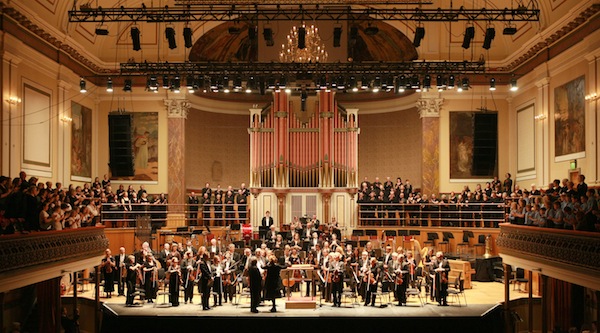
The work was performed by a combined Community Chorus comprising people who contributed to the composition, along with members of the RSNO Chorus and the RSNO at the Music Hall, Aberdeen on Thursday 6 October 2011. Now the project will be used by Scotland’s national orchestra as a successful example of how arts organisations and local communities can come together in a meaningful way to produce long-lasting legacies.
Director of Education and Community Partnerships, Ellen Thomson: “It was a huge privilege for the RSNO to run the Northlight project. We set out to take the inspirational experiences of live music making to the North East and to celebrate this with a full-scale orchestral concert with opportunities for people to take part regardless of their musical experiences. The commitment given to the project by individuals combined with the enthusiasm of all the choirs was a joy to see. We are looking forward to sharing the success of our work and the challenges we overcame throughout this eight-month project.”
Jayne Carmichael Norrie: “I cannot overestimate how instrumental the Northlight project was in the musical development of the children in my choir. Their enthusiasm, appreciation and confidence is sky high! Performing in a concert doesn’t seem to phase them that much anymore, as they have already played with some of the best musicians in the world.
“To think that when we started a majority of the children in my choir had never heard a live orchestra and they came en masse to support their RSNO friends at their recent performance of Sibelius 5 is something that makes me very proud of my choir and very grateful to the RSNO.”
Joss Atkin, Head Teacher of Tullos Primary School: “The Primary children really engaged with the project. It gave them the opportunity to be creative and original. I think they really enjoyed working as a team but also taking guidance from the professionals. The opportunity to work with other groups helped raise the profile of classical music within these communities.”
Ruth MacKenzie, Head Teacher, St Fergus Primary School: “Through Curriculum for Excellence, pupils are entitled to opportunities to achieve the highest levels they can, with support and challenge to allow them to do this. All pupils in the senior class at St. Fergus School were involved in this project from the outset, being supported by highly skilled musicians from the RSNO who listened to their ideas, teased them out and fed them back so pupils could raise their contribution to a higher standard. Their public performance offered them a unique opportunity to perform live with professional musicians, where they were supported by a large turnout of family members.
“Participating in this project was quite inspirational and we’d love to do something similar again. It really was a community project.”
The project was made possible through the generous support of TOTAL E&P UK Limited and in conjunction with Aberdeen City Council and Aberdeenshire Council.
Straight from his latest epic on Norway’s Troll Wall, Andy sets out on his fourth speaking tour which includes a date in Aberdeen.
British mountaineer Andy Kirkpatrick has a reputation for being extreme. He has a compulsive obsession with climbing the most difficult winter routes he can find, often completely alone. Described by Climbing magazine as having “a strange penchant for the long, the cold and the difficult”, he is one of the world’s most driven and accomplished mountaineers.
In the last 5 years Andy has also carved himself a niche as the UK’s only “stand-up” mountaineer, funding his dangerous trips through his outrageously funny theatre shows (Psychovertical, When Hell Freezes Over, Off the Wall) recounting his extreme adventures with a heady mix of observational comedy and self-deprecating tales of survival.
Fresh from climbing the tallest vertical rock-face in Europe, The Troll Wall in Norway, Andy will be touring the UK this autumn talking about his new book, Cold Wars. A follow up to his award-winning Psychovertical, the book charts a period of his career marked by his increasingly high-risk climbs. As his brother is drawn into the conflicts in Afghanistan and Iraq, Andy juggles family life with his climbing obsession, completing two of the most dangerous climbs on the planet – a 15-day winter ascent of the Dru in the Alps and the first winter ascent of the East face of Mermoz in Patagonia.
A gripping account of modern adventure from the UK’s most extreme mountaineer.
Following last year’s sell-out tour, Carol Smillie once again leads the cast in the hilarious comedy Hormonal Housewives, which embarks upon a limited tour of selected venues in Scotland in November 2011.
“Carol Smillie is a beautiful mover and a good actress…Julie Coombe has moments of comic genius.” The Scotsman
Join Carol Smillie and friends in an evening of excessive laughter as they battle against weight gain, weight loss, mood swings, wine, PMS, men, going to the gym, men, waxing, stretch marks, men, chocolate, upper-lip hair, chocolate, men, chocolate…and all of the other joys of being a 21st Century girl!
Julie Coombe and Shona Price also return to join Carol Smillie on stage. Hormonal Housewives is written by husband and wife team Julie Coombe and John MacIsaac.
You can catch this hilarious show at His Majesty’s in November.
'Overlooking Plockton' by Adam Bruce Thomson OBE, RSA
If you are lucky enough to be travelling on Scotland’s west coast during October then point your car, carriage or sailing boat in the direction of the Crinan Hotel. At the end of Crinan’s famous canal you will find an inspired collection of drawings and paintings by a group of 20th century Scottish artists collectively known as The Edinburgh School.
As friends and colleagues they all studied at Edinburgh College of Art in the years before and just after the second world war. They went on to become some of Scotland’s most acclaimed artists. Amongst them were Sir William MacTaggart, John Maxwell, Sir William Gillies, Denis Peploe, Anne Redpath, John Houston and Adam Bruce Thomson. The Edinburgh School is known for its virtuoso displays in the use of paint using vivid and often non-naturalistic colours. Their subjects range across still-life, seascape and landscape
A collection of around thirty paintings and drawing by these artists is on display during October at the Crinan Hotel. While many of the artists found inspiration from their travels in France and Italy, a number also found their subject matter nearer home. Houston’s dramatic East Lothian sunsets contrast vividly with Redpath’s townscape of Menton in France. Add watercolours by Blackadder and McTaggart and you have every reason to make your way to Crinan’s Gallery with Rooms. A very decent seafood bar and good autumnal rates for accommodation also make the journey well worthwhile.
The ‘Edinburgh School’ Exhibition runs until to 24th October 2011
The Crinan Hotel, Crinan by Lochgilphead, Argyll PA31 8SR, Tel: 01546 830 261
Frieda Morrison has added another string to her bow. A year of filming, a year of editing and the result is The Turning of a Year, a unique snapshot of the village of Finzean from harvest 2008 to harvest 2009.
This very special DVD diary was a community project reflecting life in the Deeside community of Finzean.
“Angus and Alison Farquharson asked me to suggest some ideas on how to celebrate their family’s 400th anniversary on Finzean, which happened to co-incide with the Homecoming in 2009,” explained award-winning broadcaster and documentary maker, Frieda Morrison. “I suggested making a video diary of the community during the build up and the year of the event.”
Frieda has lived in the Finzean area for many years. She’s an award-winning journalist and broadcaster with more than 26 years experience of producing programmes for BBC Scotland. During her years producing and presenting radio and television programmes, she has earned the reputation of being one of the country’s most successful broadcasters, winning a Green Bafta and a New York Media Festival Award for her documentaries.
The Finzean project was unlike anything she had tackled before when work began on it in October 2008.
“Angus was my second grip in the first few weeks, but he had other commitments and he was still Lord Lieutenant of Aberdeenshire at the time,” she recalled, adding that this was her first time behind the camera. “I eventually got the hang of it.”
The Turning of a Year was created in music, words and song and records the changing seasons, the folks and their festivities from the farmers’ ball to fireworks and hogmany to harvest thanksgiving. There are interviews with residents who have lived in Finzean all their days as had their forebears, with those who returned to visit during that year, and with in-aboot comers who have been absorbed into the community. And there’s music. Fiddler Paul Anderson is there and so is Finzean resident and bothy ballad king Hector Riddell. Frieda wrote the music which accompanies the stunning footage of the spectacular countryside through the seasons and one tune is dedicated to the late Ab Littlejohn whose contribution to the film is so special.
“We recorded some of the music in my house. One of the rooms has excellent acoustics and invited some of the best musicians in Scotland, many of who live locally, to participate,” Frieda said. “If you mix Paul Anderson with four part harmony singers, a whistle player and an autoharp player you get a rather special result.”
Another very special feature of the DVD is the amazing quality of light which Frieda captured, as did Joseph Farquharson, an ancestor of the present Farquharson family and a well-known artist whose work remains a favourite Christmas card scene.
A sense of community runs throughout the DVD. “Because the Year of the Homecoming happened to coincide with the 400th anniversary of the Farquharsons of Finzean it was decided to celebrate the occasion by inviting as many people as possible who had been to Finzean school to a garden party at Finzean House,” Angus explained. “400 attended, including some members of the Clan Farquharson Association. A concert in Finzean Hall, a thanksgiving service in Finzean Church and a family picnic were also held to mark a very special weekend. People attended from all over the world and it was all recorded for the DVD.”
There’s something very touching about the finished film and most people who have seen it find themselves welling up at the affectionate look at a genuinely close-knit community. However it is not a sentimentalised, rose-tinted one of a community set in aspic. The school role is healthy, there are flourishing businesses such as the farm shop and the water mill. But there is also the feel-good factor so often associated with Sunday-evening television programmes.
While devoting two years of her life to this project, Frieda also completed an MSc in management at the Robert Gordon University Business School and produced a CD of her own songs. She also set up her own website and blog which you can access here.
The DVD will be launched at a gathering in Finzean on November 19 and will be on sale in the farm shop, price £15.
“The finished result is a personal triumph and will become a classic of its kind,” predicts Angus Farquharson.
Two original copies of the Aberdeen Breviary, Scotland’s first substantial printed book, will go on display in Edinburgh tomorrow (Friday, November 5) to mark the 500th anniversary of its completion.
Dating back to 1510, the copies of this important prayer book will form the centrepieces of the National Library of Scotland’s (NLS) latest ‘treasures’ display together with illuminated manuscripts and some of the earliest printed books brought to Scotland – a not to be missed opportunity to see the two books, held by two different libraries, side by side. One copy belongs to NLS while the other is owned by Aberdeen University Library.
The Aberdeen Breviary was compiled under the direction of Bishop William Elphinstone (Bishop of Aberdeen, founder of Aberdeen’s King’s College and counsellor to James III and James IV) and was designed to be recited by the Scottish clergy throughout the liturgical year.
It is also the book which brought the printing press to Scotland. The country’s first printers, Walter Chepman and Androw Millar, were granted a patent by James IV in 1507 to ‘bring home a printing press…for printing within our realm’ breviaries and other service books, of which the Aberdeen Breviary was the only one to be printed.
Helen Vincent, Senior Rare Books Curator at the National Library of Scotland, said: “Only five copies of the Aberdeen Breviary are known to survive, along with some fragments – we know of others which are now lost, such as one which vanished from the Scots College in Paris during the French Revolution. This may be the first time these two copies have come together since they sat side by side in Walter Chepman’s printing house five hundred years ago.
“The Aberdeen Breviary illustrates how active the Renaissance was in Scotland. Elphinstone’s engagement of humanist scholars to investigate the lives of Scottish saints, James IV’s love of new technology and desire for a modern centralised state, the enterprise and initiative of Walter Chepman – all these combined to produce one of the great neglected achievements of the period. We hope this exhibition will rekindle people’s interest in this exciting period of Scottish history and in the Breviary itself – incredibly it has never been completely translated into English.”
The National Library of Scotland (NLS) was delighted to join forces with Aberdeen University Library (AUL) to make the treasures display possible.
Professor Peter Davidson, Chair in Renaissance Studies at the University of Aberdeen, emphasised the huge significance of the Aberdeen Breviary, calling it “one of the greatest intellectual enterprises of Renaissance Scotland”.
He said: “This book, rich in commemorations of the feasts of Scottish saints, is an attempt to foster a distinctively Scottish church, within the frame of international Catholicism.
“This book was only one of a series of modernising initiatives which Elphinstone supported as Bishop of Aberdeen and Chancellor of Scotland. He encouraged the compilation of Hector Boece’s History of the Scots, which was for many centuries a key text of Scottish identity, and he founded Scotland’s third ancient University – King’s College, Aberdeen – which later joined with the other Aberdonian University College, Marischal, to form the modern University of Aberdeen.”
The two magnificent books will be in good company alongside contemporary treasures from the collections of NLS and AUL, including a carefully-selected collection of illuminated manuscripts and incunables – books printed before 1500. (See notes to editors for a more detailed breakdown of exhibition items).
The display ‘The Aberdeen Breviary: the 500th Anniversary of the Printing of ‘Our Own Scottish Use’ – which will be showcased within the National Library of Scotland’s public exhibition space on George IV Bridge, Edinburgh – will run from November 5 until January 9.
If you would like to find out more about the items on display, visit the National Library of Scotland’s Rare Book blog during the exhibition, at: http://blogs.nls.uk/rarebooks